


Syllabus: GS1/ Culture
Context
- The Ministry of Culture has launched a first-of-its-kind, three-month nationwide survey to map India’s vast manuscript heritage.
- The initiative is part of the Gyan Bharatam Mission, announced in the Union Budget 2025–26.
Gyan Bharatam Mission
- Gyan Bharatam Mission: It is a national mission for the survey, documentation, digitisation and dissemination of India’s manuscript heritage and traditional knowledge systems, including creation of a National Digital Repository.
- To support the initiative, the Standing Finance Committee (SFC) has sanctioned Rs.491.66 crore for the period 2025-2031.
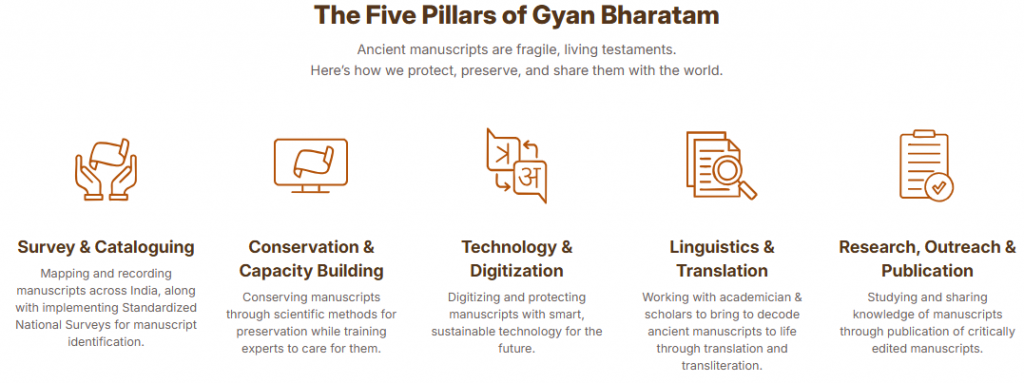
Significance of the initiative
- Preservation of Heritage: Digitisation and documentation will protect fragile manuscripts from deterioration and loss.
- Research Accessibility: A centralised repository will enable easier access for scholars and the public.
- Curbing Intellectual Piracy: Proper records and metadata will help establish authenticity and prevent misuse.
- Cultural Revival: Greater visibility will promote India’s literary and knowledge traditions.
What are Manuscripts?
- A manuscript is a handwritten composition on materials such as palm leaf, birch bark, cloth, paper, or even metal, dating back at least seventy-five years and carrying significant historical, scientific, or aesthetic value.
- It represents India’s cultural consciousness and knowledge systems.
- The Gilgit Manuscripts written between the 5″-6″ centuries CE, is the oldest surviving manuscript collection in India.
- It is written in the Buddhist hybrid Sanskrit language of the Gupta Brahmi and Post Gupta Brahmi script of that period.
- The manuscripts include Buddhist works that throw light on the evolution of Sanskrit, Chinese, Korean, Japanese, Mongolian, Manchu and Tibetan religion-philosophical literature.
Other measures to conserve Manuscript Heritage
- National Mission for Manuscripts, established in 2003 has documented over 44.07 lakh manuscripts through its ambitious digital repository, Kriti Sampada.
- Abhilekh Patal is an initiative of the National Archives of India to provide online access to over a million files, including a significant collection of manuscripts, oriental records, and private papers.
- Gyan-Setu: It was launched as a national challenge to source AI-led solutions for manuscript preservation, decipherment, restoration and access.
- Antiquities and Art Treasures Act, 1972: It seeks to prevent the illegal export and smuggling of India’s cultural heritage, including valuable manuscripts.
- Manuscripts and records qualify as antiquities if they are at least 75 years old.
- UNESCO Memory of the World Programme: It recognises and promotes preservation of documentary heritage, including rare manuscripts.
National Archives of India
- The National Archives of India was established in 1891 in Kolkata (Calcutta) as the Imperial Record Department.
- Following the transfer of the capital from Calcutta to Delhi in 1911, the building of the National Archives of India was constructed in 1926 which was designed by Sir Edwin Lutyens.
- The transfer of all records from Calcutta to New Delhi was completed in 1937.
- It is also the nodal agency for the implementation of the Public Records Act, 1993 and Public Record Rules, 1997.
Source: TOI
Previous article
News In Short 16-03-2026
